



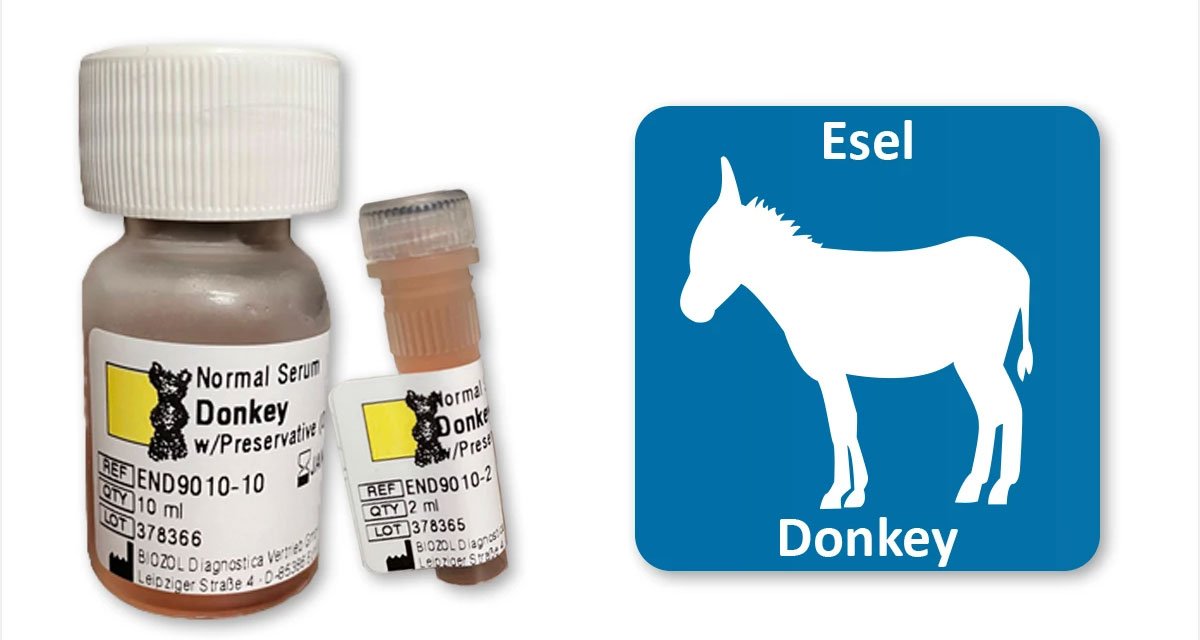
Immunological research often depends on small reagent choices that shape whether a signal looks trustworthy or misleading. Donkey serum occupies one of those narrow, valuable positions. It appears less often than bovine or goat products, yet selected assays still rely on it for cleaner blocking. Teams reach for this material when background staining rises, secondary binding drifts, or faint cellular markers risk being buried by visual noise.
Low Cross-Reactivity Matters
Background staining rarely comes from one source alone. Endogenous proteins, tissue charge, and secondary mismatch can each blur interpretation. In that setting, sterile filtered donkey serum often enters protocols because donkey proteins may create fewer unintended contacts during staining with rabbit, sheep, or goat antibodies. That practical difference can sharpen contrast, reduce haze, and help weak antigen signals remain visible under routine microscopic review.
A Better Fit for Complex Antibody Panels
Multiplex staining adds pressure with every added reagent. One weak match can disturb an entire panel. Donkey serum proves useful where several primaries, distinct species, and layered detection steps must work without overlap. Many groups prefer it when donkey-derived secondary antibodies anchor the design. That pairing can calm stray attachment, preserve separation between channels, and give image analysts cleaner material for downstream interpretation.
Blocking Quality Affects Data Quality
Blocking may look routine on paper, yet it often decides whether a result feels convincing. Poor coverage can produce edge glow, diffuse mist, or patchy brightness across sections. Donkey serum helps limit those artifacts in tissues and cultured cells carrying delicate markers. A small gain in clarity matters. Fewer repeats save specimens, protect timelines, and keep observer agreement tighter during blinded review.
Why It Stays Niche
Donkey serum remains uncommon for practical reasons rather than scientific weakness. Supply is narrower, pricing runs higher, and many standard assays perform adequately with cheaper sources. Most laboratories, therefore, reserve donkey material for situations where ordinary blockers fail. That pattern keeps usage selective. Its narrow demand says little about worth. Instead, it reflects a reagent chosen for fit, not broad routine convenience.
Performance in Immunohistochemistry
Immunohistochemistry places unusual stress on every blocking reagent. Fixation alters epitopes, the extracellular matrix traps proteins, and dense architecture encourages stray attachment. Donkey serum can help quiet those distractions while preserving local detail. Vascular borders, stromal bands, and crowded immune clusters often read more cleanly after careful blocking. That matters in pathology studies, where placement, intensity, and cellular shape each carry interpretive weight.
Support for Fluorescence Assays
Fluorescence methods amplify small differences, though they also magnify stray background. A slight rise in nonspecific binding can wash dim targets into the field. Donkey serum helps reduce that interference before labeled antibodies arrive. That practical difference can sharpen contrast, reduce haze, and help weak antigen signals remain visible under routine microscopic review. This benefit becomes useful during low-abundance marker work, especially in neural or immune tissue. Cleaner preparation supports steadier thresholding and improves confidence in later quantitative image analysis.
Lot Consistency Still Counts
Species choice matters, yet batch behavior often matters just as much. Blocking can shift if protein composition changes between lots, even under stable staining conditions. Laboratories therefore watch sourcing, sterile processing, and storage history closely. Those details affect reproducibility across months of related work. A familiar serum with dependable handling records reduces avoidable variation and protects long-term comparisons within a single research program.
It Solves Problems Other Serums Miss
Goat, horse, and bovine sera each serve useful roles across laboratory practice. Some assays, though, remain noisy until donkey serum replaces the original blocker. That pattern appears in stubborn stains with persistent haze or species combinations prone to secondary interference. Researchers keep this reagent in reserve for good reason. It addresses a narrow technical set repeatedly, even while broader products remain common elsewhere.
Conclusion
Donkey serum keeps its specialized place because immunological methods do not all fail in the same way. Some problems stem from tissue chemistry, others from antibody pairing, and others from weak target abundance. In those settings, donkey serum can preserve cleaner staining and steadier interpretation where generic blockers fall short. Its niche status reflects careful use, rather than limited merit, and that distinction explains its lasting value in research.