


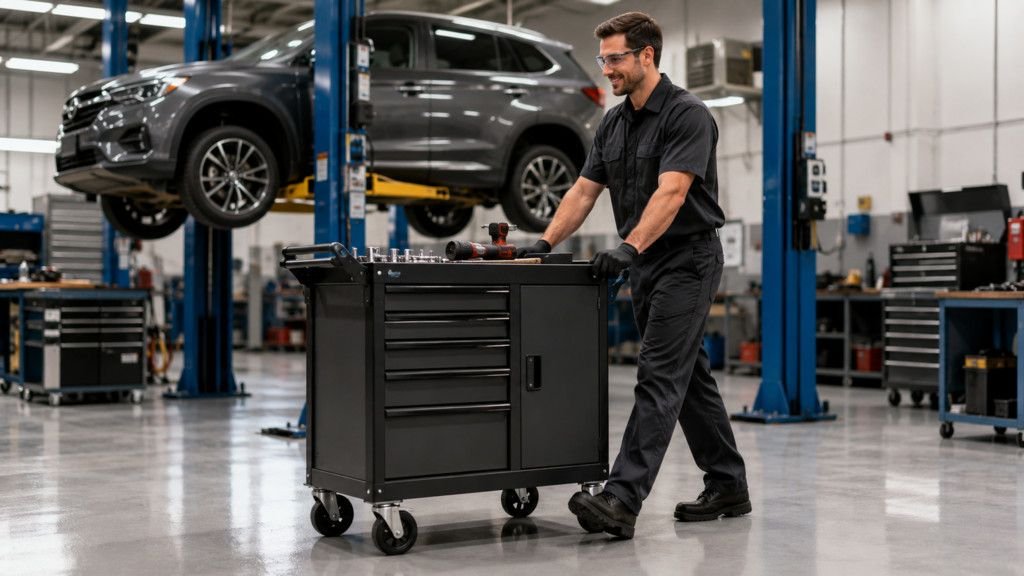
Automotive service departments depend on movement. Technicians move tool carts, tire racks, oil drain pans, diagnostic equipment, engine stands, battery chargers, transmission jacks, parts bins, and mobile workstations throughout the day. When Casters are poorly matched to the equipment, floor surface, and working conditions, every push, pull, turn, and stop becomes harder than it should be. Better wheel systems, including swivel casters in the right positions, can reduce technician strain, improve control, and help service teams work with less physical stress.
Technician strain is not always caused by one major lift or accident. In many shops, it builds through repeated small movements. A cart that takes extra force to start rolling, a stand that does not turn cleanly, or a rack that shakes over uneven flooring can add stress to the shoulders, wrists, back, knees, and hips. Over time, these repeated movements can affect comfort, speed, morale, and safety.
Better rolling hardware does not solve every workplace challenge, but it can make a noticeable difference when selected carefully. The key is to match the wheel assembly to the load, floor, movement pattern, equipment type, and technician workflow.
Why technician strain matters in service departments
Automotive work is already physically demanding. Technicians lift parts, bend into engine bays, kneel near wheels, reach under vehicles, handle tools, and move around lifts all day. When the equipment they rely on is hard to move, it adds another layer of fatigue.
For example, a fully loaded tool cart may weigh far more than it appears. A tire rack can become difficult to steer when loaded unevenly. An oil drain unit may roll smoothly when empty but become harder to control once filled. A mobile diagnostic station may be light but still annoying to move if the wheels chatter, drag, or catch on floor cracks.
These issues affect more than comfort. Strain can slow down repair times, increase the risk of mistakes, and create frustration during busy service hours. A technician who has to fight with a rolling cart several times a day may spend less energy on the actual repair task. In high-volume service departments, small movement issues can add up across many employees and many repair orders.
Good rolling equipment supports the body by reducing the effort needed to move, turn, position, and stop shop tools and service equipment.
Push force and why it matters
One of the most important factors is push force. This refers to the effort needed to start moving an object and keep it moving. A cart may be rated to carry a heavy load, but if the wheels are too small, too hard, too soft, or poorly suited to the floor, the technician may still need excessive force to move it.
There are two parts to this problem. The first is starting force. This is the force needed to get a stationary object moving. The second is rolling force. This is the effort needed to keep it moving once it starts.
In service departments, starting force is often the bigger strain issue. Technicians rarely push equipment in long, straight paths. They move a cart a few feet, stop, turn, reposition, and move again. Each start and turn places stress on the body. If the wheel system resists movement, the technician compensates with the shoulders, lower back, arms, and legs.
Larger wheel diameters often reduce effort because they roll more easily over floor joints, debris, cracks, and small obstacles. However, larger wheels can raise equipment height, which may not work for every tool cart or service unit. This is one of the main trade-offs. A bigger wheel may reduce rolling effort, but it can also affect equipment stability, working height, and storage clearance.
Wheel material and floor conditions
Wheel material has a major effect on technician strain. Automotive service floors are usually concrete, but the condition of that concrete varies widely. Some bays have smooth sealed floors. Others have rough patches, expansion joints, drains, oil residue, old coatings, or small debris.
Harder wheel materials may roll more easily under heavy loads, but they can be louder and less forgiving on rough floors. Softer wheel materials may absorb vibration better and protect floors, but they can create more rolling resistance, especially under heavy weight. Polyurethane is often chosen because it can offer a useful balance between load support, floor protection, and easier movement. Rubber may help with noise and vibration, but it may not be ideal for every heavy-duty shop use. Steel or iron wheels may carry heavy loads, but they can be noisy and harsh on floors.
The right choice depends on the shop. A dealership service department with polished floors may need different wheel systems than a heavy truck repair facility with rough concrete and outdoor transitions. Choosing only by price or load rating can lead to poor results if floor conditions are ignored.
Load capacity and real-world weight
Load rating is another key factor. Many buyers look at the listed capacity of a wheel assembly and assume it is enough. However, real-world use can be more demanding than static weight suggests.
A tool cart may carry more weight over time as technicians add tools, chargers, specialty equipment, and parts. A rolling rack may carry uneven loads. A mobile platform may be pushed over floor seams or turned sharply under load. All of these conditions can create extra stress on the wheel system.
A safer approach is to account for the full loaded weight, not just the empty equipment weight. It is also important to consider how the load is distributed. If weight shifts to one side or one corner, one wheel may carry more than expected.
The trade-off is that higher-capacity wheel assemblies may cost more and may be larger or heavier. Yet choosing a unit too close to the maximum load rating can lead to harder movement, faster wear, and more technician effort. In many service departments, a modest increase in load rating can help improve reliability and reduce strain over time.
Turning, positioning, and control
Automotive service departments often have tight spaces. Vehicles sit on lifts, technicians work around open doors, toolboxes line the walls, and parts move between bays. Equipment must turn, pivot, and stop without creating extra effort.
Pivoting wheel units are helpful when equipment needs to move in multiple directions. They allow carts and stands to turn in place, which can reduce awkward body positions. However, too much free movement can also make heavy equipment harder to control.
For example, a cart with all pivoting wheels may be easy to turn but may wander when pushed in a straight line. A setup with two fixed wheels and two pivoting wheels may track better, but it may require more space to turn. The right layout depends on the use case.
A technician moving a small diagnostic cart may benefit from maximum maneuverability. A heavy parts rack that travels longer distances may need better straight-line tracking. An engine stand may need careful balance between movement and stability. This is where the trade-off between steering freedom and control becomes important.
Brakes and locking features
Brakes can reduce strain by preventing unwanted movement while technicians work. A mobile workstation that rolls away during use forces the technician to reposition it again and again. An oil drain pan that shifts near a lift can create safety concerns. A parts cart that moves while loading or unloading can increase awkward reaching and bending.
Wheel brakes, total-lock mechanisms, and directional locks can help. A total-lock setup can stop both wheel rotation and pivoting movement, giving better stability. A directional lock can make a pivoting unit behave more like a fixed one when straight tracking is needed.
The challenge is convenience. If brakes are hard to reach, stiff, or poorly placed, technicians may not use them consistently. A brake pedal should be easy to operate with a foot, placed where it is accessible, and strong enough for the equipment’s load. Otherwise, the feature exists but does not help the workflow.
Noise, vibration, and fatigue
Strain is not only physical force. Noise and vibration also contribute to fatigue. A cart that rattles across a shop floor may seem like a minor issue, but repeated vibration can travel through the hands, wrists, elbows, and shoulders. It can also make the workplace feel more chaotic.
Wheel material, bearing type, wheel diameter, and floor condition all affect vibration. Larger wheels often roll more smoothly over uneven surfaces. Softer treads can reduce noise and shock, but they may also increase rolling resistance under certain loads. Bearings can also make a major difference. A poor bearing may drag, squeak, or require extra force. A better bearing can support smoother movement and reduce the effort needed from the technician.
The best option is not always the quietest option. A very soft wheel may reduce noise but may not carry the load well. A very hard wheel may roll easily but create more vibration. The decision should be based on the full work setting, not one factor alone.
Shop layout and workflow
Even the best wheel assemblies cannot fully compensate for a poor shop layout. If technicians must move equipment around tight corners, across cluttered floors, or through crowded walkways, strain will remain a problem.
Rolling hardware should be selected along with workflow planning. Service departments should look at where equipment starts, where it travels, how often it moves, and who moves it. A cart used by one technician in one bay has different needs than a shared tool cart moved across the shop. A tire cart used near vehicle lifts has different needs than a parts cart moving between storage and service lanes.
Decision-makers should also consider technician height, reach, and working posture. If a larger wheel raises a cart too much, it may reduce rolling effort but create poor working height. If a smaller wheel keeps the cart at a comfortable height but makes it harder to push, that also creates a problem. The goal is to support the whole task, not just the movement from one point to another.
Maintenance and long-term performance
A good wheel system still needs maintenance. Debris, hair, metal shavings, chemical residue, and dirt can affect performance. Bearings may wear down. Brakes may loosen. Treads may crack, flatten, or separate. Mounting plates may loosen over time.
Service departments should inspect rolling equipment as part of routine shop safety checks. Warning signs include wobbling, uneven rolling, squeaking, flat spots, loose hardware, dragging wheels, poor braking, and increased push effort.
There is a trade-off between buying low-cost replacements often and choosing better-grade equipment that lasts longer. Lower upfront cost may seem attractive, especially for large shops with many carts and racks. However, frequent replacement, downtime, technician frustration, and possible safety risks can reduce the real savings. A slightly higher-quality wheel assembly may provide better long-term value if it reduces effort and lasts under daily use.
Challenges in choosing the right solution
One challenge is that service departments use many types of equipment. A single wheel type will not work well for every cart, rack, stand, and mobile unit. Another challenge is that many buyers choose based on size alone. They may match the old wheel diameter without checking load rating, tread material, bearing type, mounting pattern, or brake style.
There is also a knowledge gap. Technicians may know what feels wrong, but they may not describe it in product terms. They might say a cart is “hard to push” or “doesn’t turn right,” while the actual cause may be wheel diameter, tread wear, bearing failure, load mismatch, or poor layout.
The best decisions usually come from combining technician feedback with product knowledge. Ask where the equipment is used, what it carries, how often it moves, what floor it travels on, and what problems technicians notice. This information helps narrow the options and avoid replacing one poor-fit part with another.
Here is the small paragraph and the link we would like to add: “Selecting the right caster involves more than matching load capacity, it also requires considering wheel material, floor conditions, mounting options, and the specific demands of the application. Having access to detailed technical guidance and product information from resources such as Caster City can help maintenance teams make informed decisions that improve equipment mobility, reduce unnecessary wear, and support safer, more efficient workplace operations.
Why the impact on technicians should guide decisions
When buying or replacing rolling hardware, it is easy to focus on cost, size, or availability. Those factors matter, but the effect on technicians should be part of the decision. The people moving the equipment every day feel the real difference between a smooth, controlled cart and one that drags, shakes, or turns poorly.
Better movement can support safer posture, lower fatigue, quicker positioning, and a calmer work environment. It can also help service departments protect equipment, reduce floor damage, and maintain better workflow during busy periods.
The right choice is rarely about buying the most expensive option. It is about matching the wheel system to the job. Load, floor, movement pattern, braking needs, noise, vibration, and technician comfort all matter. When these factors are balanced well, automotive service departments can reduce daily strain and help their teams work with greater control and less unnecessary effort.