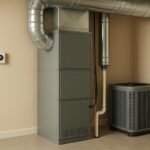



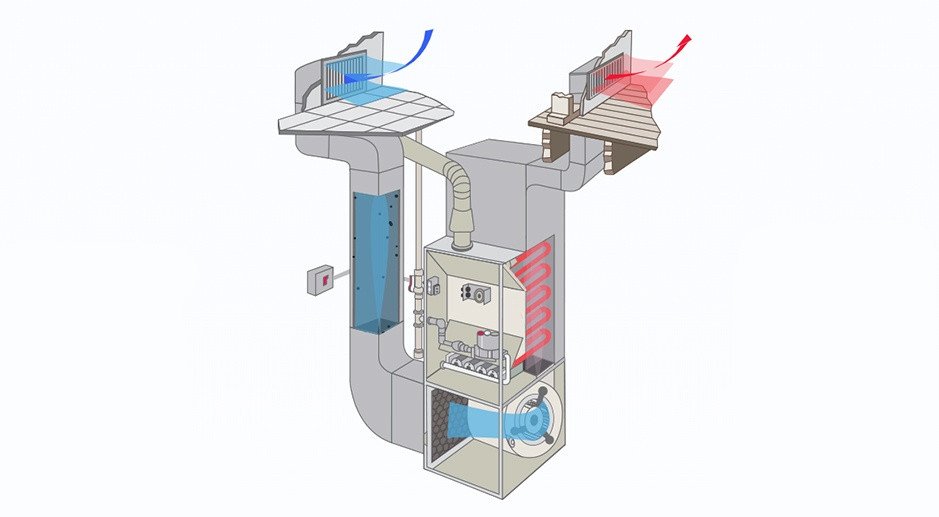
A condensing furnace works by extracting heat from the combustion gases twice — once in the primary heat exchanger, where the hot gases give up roughly 80% of their thermal energy to the air circulating through the house, and a second time in the condensing heat exchanger, where the now-cooled gases condense their water vapor into liquid water, releasing the latent heat of vaporization into the house air. The U.S. Department of Energy describes high-efficiency heating systems as “condensing flue gases in a second heat exchanger for extra efficiency” with an AFUE rating of “90% to 98.5%” (energy.gov). The secondary heat exchanger is the defining component of a condensing furnace. It is the difference between an 80% furnace and a 95% furnace.
The physics is straightforward. Natural gas is mostly methane — CH₄. When methane burns completely, the chemical reaction is CH₄ + 2O₂ → CO₂ + 2H₂O + heat. For every molecule of methane burned, two molecules of water vapor are produced. That water vapor carries roughly 9,700 BTU of latent heat per gallon of water — heat that is trapped in the vapor phase and goes up the chimney of a conventional furnace as steam. A condensing furnace cools the exhaust gases below the dew point of water — roughly 130°F — at which point the water vapor condenses into liquid water. The phase change from vapor to liquid releases the latent heat, which is captured by the secondary heat exchanger and transferred to the house air. The water that drips from the furnace — roughly 2 to 4 gallons per day — is the combustion water vapor that would have been wasted up the chimney of an 80% furnace.
The Primary and Secondary Heat Exchangers: Two Stages of Heat Extraction
| Feature | Primary Heat Exchanger | Secondary Heat Exchanger |
| Where in the gas path | First — directly above the burner | Second — after the primary, before the vent |
| Gas temperature entering | 1,500-2,000°F | 300-500°F |
| Gas temperature exiting | 300-500°F | 100-120°F |
| What it extracts | Sensible heat (temperature drop) | Sensible heat + latent heat (phase change) |
| Material | Aluminized steel or stainless steel | Stainless steel (must resist acidic condensate) |
The secondary heat exchanger must be made of stainless steel — typically 316L or a proprietary alloy — because the condensate is acidic. The combustion of natural gas produces not only CO₂ and water vapor but also trace amounts of nitrogen oxides and sulfur compounds from the odorant added to the gas. These dissolve in the condensed water to form a weak carbonic and sulfuric acid solution with a pH of roughly 3.5 to 5.0 — roughly the acidity of orange juice. Aluminum and mild steel corrode rapidly in this environment. Stainless steel resists it for the 20- to 30-year design life of the furnace. The DOE notes that “high-efficiency sealed-combustion units generally produce an acidic exhaust gas that is not suitable for old, unlined chimneys” (energy.gov) — the same acidic condensate that requires a stainless steel secondary heat exchanger also requires a PVC vent pipe and a condensate drain that can handle acidic water.
Why the Exhaust Is Cool Enough for PVC
The exhaust gases leaving the secondary heat exchanger are 100°F to 120°F — cool enough to be vented through Schedule 40 PVC pipe. The DOE confirms that “PVC pipe… is safely used in condensing furnaces” (energy.gov). A conventional 80% furnace produces exhaust gases at 300°F to 400°F, which would melt PVC on contact and must be vented through metal. The cool exhaust is the direct result of the secondary heat exchanger doing its job — the gas temperature drops below the dew point, the water condenses, and the heat that was in the water vapor is now in the house air. The cooler the exhaust, the more heat was extracted. The PVC vent is a visible signal that the furnace has a secondary heat exchanger.
Sealed Combustion: Why Two Pipes Are Better Than One
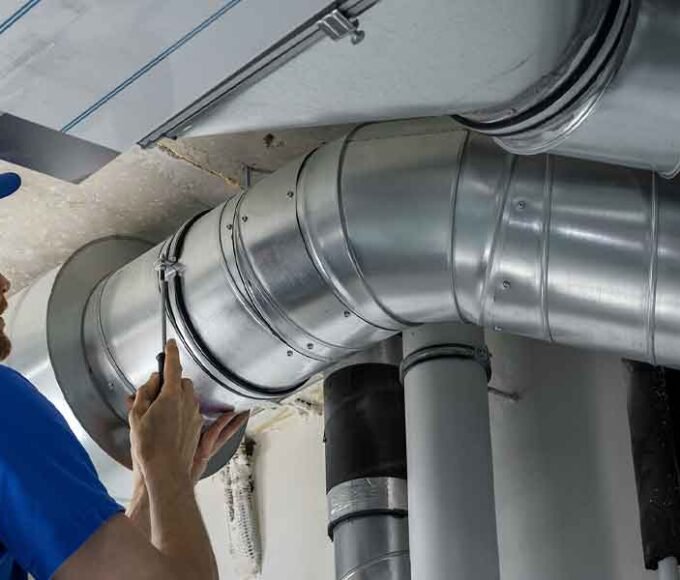
Most condensing furnaces use sealed combustion — a two-pipe system where one PVC pipe brings outside air directly into the sealed burner compartment, and the other PVC pipe exhausts combustion gases to the outside. The DOE describes sealed combustion as a system that “will bring outside air directly into the burner and exhaust flue gases directly to the outside, without the need for a draft hood or damper” and notes that “sealed-combustion units avoid [back-drafting] and also pose no risk of introducing dangerous combustion gases into your house” (energy.gov).
The sealed burner compartment means the furnace does not draw combustion air from the room it sits in. It does not compete with the clothes dryer, the range hood, or the bathroom exhaust fan for combustion air. It is unaffected by negative pressure in the house. And because the burner compartment is sealed, the risk of combustion gases escaping into the house from a cracked heat exchanger is reduced — the burner is isolated from the house air by the sealed compartment walls.
The Condensate: Where the Water Goes
The 2 to 4 gallons of acidic condensate produced per day must drain somewhere. The furnace has an internal condensate trap that prevents combustion gases from escaping through the drain line. The condensate flows from the trap through a PVC or vinyl tube to a floor drain, a condensate pump, or a laundry sink. Most jurisdictions allow condensing furnace condensate to drain into the household sanitary sewer without treatment. The acidity is mild enough — pH 3.5 to 5.0 — that municipal wastewater treatment plants can handle it without issue.
If the home is on a septic system, the condensate should be neutralized before entering the septic tank. A condensate neutralizer — a small cartridge filled with calcium carbonate or magnesium oxide pellets that raise the pH to near-neutral — costs $50 to $150 and lasts roughly 1 to 2 years before the pellets dissolve and need replacement. The acidic condensate can kill the beneficial bacteria in a septic tank if the volume is high relative to the tank size.
Maintaining a healthy balance of bacteria is vital for any home drainage system to function correctly over time. When these natural processes are disrupted by chemical imbalances or extreme acidity, it can lead to more frequent maintenance needs or even system failure. Regular inspections can help identify these issues early, ensuring your equipment and waste management systems remain efficient. For homeowners who want to understand more about balancing system health with high-efficiency hardware, learning about professional care and routine checks is a practical step. This proactive approach helps extend the life of your home infrastructure and provides more peace of mind during peak heating seasons.
Condensing vs. Conventional Furnace: The 15-18% Efficiency Gap
| Feature | Conventional (80% AFUE) | Condensing (90-98.5% AFUE) |
| Heat exchangers | One — primary only | Two — primary + secondary |
| Exhaust temperature | 300-400°F | 100-120°F |
| Exhaust vent material | Metal — galvanized or B-vent | PVC — Schedule 40 |
| Combustion air | From the room (natural or induced draft) | From outside (sealed combustion) |
| Condensate produced | None — water vapor escapes as steam | 2-4 gallons per day |
| Draft type | Natural draft or fan-assisted | Forced draft — inducer pushes exhaust |
FAQ: Common Questions About Condensing Furnaces
Will my condensing furnace stop working if the condensate line freezes?
Yes. If the condensate drain line freezes — typically in an unconditioned attic, a crawlspace, or where the drain line exits the house — the water backs up into the furnace. The internal pressure switch detects the blockage and shuts off the furnace to prevent combustion gases from being forced through the backed-up drain. A frozen condensate line is the most common cold-weather shutdown for condensing furnaces. The fix is to insulate the exposed portion of the drain line with closed-cell pipe insulation and, in attics or exterior walls, add heat tracing — a self-regulating electric heating cable that wraps around the pipe and prevents freezing.
Can I replace my 80% furnace with a condensing furnace using the existing chimney?
No. The DOE specifically warns that condensing furnaces “produce an acidic exhaust gas that is not suitable for old, unlined chimneys.” The old chimney can be used as a chase — a passageway to run the new PVC vent pipes through — but the PVC pipes must run continuously from the furnace to the outside termination. The exhaust cannot be vented into the chimney and allowed to rise through the masonry flue. If the old chimney is no longer needed, it should be properly capped at the top to prevent rain and animals from entering.
The Second Heat Exchanger Is the Invention That Made the Condensing Furnace Possible
A condensing furnace works by adding a second heat exchanger that cools the combustion gases below the dew point of water, condensing the water vapor into liquid and capturing the latent heat that an 80% furnace wastes up the chimney. The exhaust temperature drops from 400°F to 100°F. The efficiency rises from 80% to 95% or higher. The exhaust is cool enough to vent through PVC. The condensate drains to the household sewer.
The stainless steel secondary heat exchanger, the PVC vent pipe, and the condensate drain system are the three components that distinguish a condensing furnace from a conventional furnace. All three exist because of the condensation process. If the furnace did not condense water, it would not need a stainless steel heat exchanger, a PVC vent, or a drain line. The condensation is the efficiency. The hardware exists to manage the condensation.