


Synthetic roof underlayment is a woven or spun-bonded polypropylene or polyethylene sheet that serves as the secondary water barrier between the roof deck and the shingles, replacing the asphalt-saturated felt paper — commonly called tar paper or felt — that was the industry standard for the previous century. It is lighter, stronger, more tear-resistant, and more dimensionally stable than felt, and it has become the default underlayment on the majority of new residential roof installations in the United States in the last 15 years.
The product exists because felt paper has a fundamental weakness: it absorbs water. When felt gets wet, it swells, wrinkles, and loses strength. If a shingle blows off during a storm before the roof can be repaired, the exposed felt paper is a temporary water barrier that lasts a few days. Synthetic underlayment under the same conditions can be left exposed to the weather for 6 to 12 months without degrading — a rating called UV exposure tolerance that felt paper does not have. A roofer who gets rained out on a Tuesday can leave the synthetic underlayment exposed until Thursday, and it will still be intact. Felt paper under the same conditions would be wrinkled and tearing at the fastener lines by Wednesday morning.
Synthetic Underlayment vs. Felt Paper: The Key Differences
| Property | Synthetic Underlayment | Asphalt Felt (#15 / #30) |
| Base material | Woven or spun polypropylene/polyethylene | Cellulose (paper) saturated with asphalt |
| Weight per square (100 sq ft) | 6-12 lbs | 15-30 lbs |
| Tear resistance | High — resists tearing at fasteners | Low — tears easily when wet or in wind |
| Water absorption | None — hydrophobic | Absorbs water, swells, wrinkles |
| UV exposure rating | 6-12 months | Days to weeks (varies) |
| Slip resistance | Textured surface, good traction | Smooth when dry, slippery when wet |
| Vapor permeability | Variable (1-50 perms depending on product) | Moderate (5-10 perms) |
| Cost per square | $15-$30 | $8-$15 |
The weight difference is the feature roofers notice first. A roll of #30 felt paper covering 200 square feet weighs roughly 60 pounds. A roll of synthetic underlayment covering the same area weighs roughly 15 pounds. A roofer carrying rolls up a ladder all day will take the synthetic every time. The safety difference — lighter rolls, better traction on the installed surface — is significant enough that some roofing contractors have switched to synthetic entirely for crew safety, not for performance.
Types of Synthetic Underlayment: Mechanically Attached vs. Self-Adhered
Synthetic underlayment comes in two installation types, and the choice affects the waterproofing performance, the cost, and the labor required.
Mechanically attached synthetic underlayment is fastened to the roof deck with plastic cap nails or staples along the top edge of each course, with subsequent courses overlapping the fasteners. It is the standard product for most residential asphalt shingle roofs and costs $15 to $25 per square. The fasteners create penetrations through the underlayment, which is why mechanically attached underlayment is a secondary water barrier — not a primary waterproofing layer. Water that gets under the shingles drains down the surface of the underlayment to the eave without reaching the deck.
Self-adhered synthetic underlayment — also called peel-and-stick underlayment — has an adhesive backing that bonds directly to the roof deck over the entire surface. There are no mechanical fasteners, and therefore no penetrations through the waterproofing layer. It is a fully adhered membrane that seals around roofing nails driven through it during shingle installation, providing a primary water barrier rather than a secondary one. Self-adhered underlayment costs $50 to $80 per square and is typically used in high-risk areas — eaves, valleys, around penetrations, and on low-slope roofs — rather than on the entire roof surface. A full roof covered in self-adhered underlayment is the most watertight underlayment system available, but it is also the most expensive, adding $2,000 to $4,000 to a typical roof replacement.
The difference between synthetic underlayment and ice & water shield: Ice and water shield is a specific type of self-adhered underlayment — a rubberized asphalt membrane with a polymer film surface — designed for use at the eaves, in valleys, and around penetrations. Synthetic underlayment is the general-purpose field underlayment that covers the rest of the roof. They are complementary products, not substitutes. Ice and water shield goes in the vulnerable areas. Synthetic goes everywhere else.
Vapor Permeability: Why It Matters for Roof Longevity
The one performance characteristic where synthetic underlayment is not automatically superior to felt paper is vapor permeability — the ability of the underlayment to allow water vapor to pass through it from the attic side to the outside. A roof assembly needs to breathe. Moisture that accumulates in the attic from cooking, showering, and respiration must be able to escape through the roof assembly, or it condenses on the underside of the underlayment and rots the roof deck.
Felt paper is moderately vapor-permeable — roughly 5 to 10 perms when dry, increasing when wet — which is one of the reasons it worked for 100 years. Synthetic underlayment varies widely: some products are highly vapor-permeable (30 to 50 perms), and some are vapor barriers (less than 1 perm). A vapor-impermeable synthetic underlayment installed over a poorly ventilated attic traps moisture against the underside of the deck, accelerating rot.
If your attic is well-ventilated — ridge vent with continuous soffit vents, meeting the 1:150 ratio of vent area to attic floor area — vapor permeability is not a concern, and any synthetic underlayment will perform well. If your attic is poorly ventilated or unventilated, specify a high-permeability synthetic underlayment (20 perms or higher) to avoid trapping moisture in the roof assembly.
How Synthetic Underlayment Is Installed
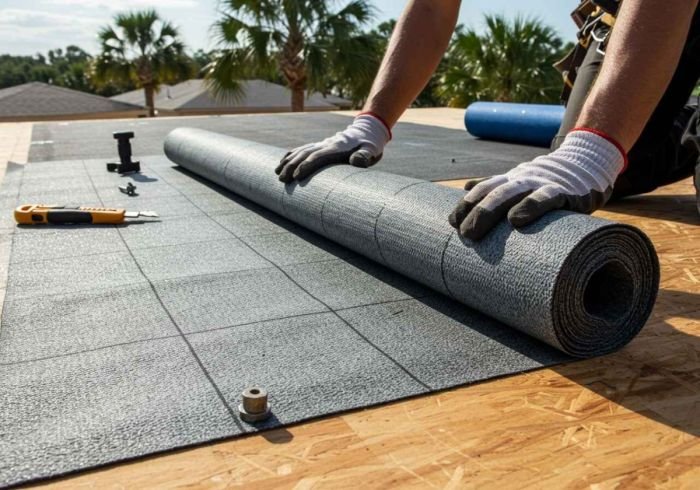
Synthetic underlayment is installed in horizontal courses, starting at the eave and working up to the ridge, with each course overlapping the course below it by 4 to 6 inches. The overlap is critical — water that gets under the shingles flows down the surface of the underlayment, and an overlap in the wrong direction (upper course tucked under the lower course) directs water under the underlayment instead of over it.
The manufacturer’s instructions specify the fastener type and spacing. Plastic cap nails — nails with a 1-inch plastic disc under the head — are standard because the cap prevents the nail head from pulling through the underlayment in high winds. Staples are acceptable for some products but provide less holding power. The fasteners are placed along the top edge of each course, where they will be covered by the overlap of the next course. Fasteners placed in the middle of the sheet — in the field — are exposed to water flowing down the surface and will eventually leak.
The underlayment must be pulled tight and flat, with no wrinkles, before fastening. A wrinkle in the underlayment telegraphs through the shingles above it, creating a visible ridge in the finished roof surface. The shingles will bridge over the wrinkle, and over time, the repeated expansion and contraction of the bridging shingle will crack it along the ridge line.
Synthetic Underlayment Cost Comparison
| Underlayment Type | Material Cost / sq | Installed Cost / sq | 2,000 sq ft Roof Total |
| #15 Asphalt Felt | $8-$10 | $20-$30 | $400-$600 |
| #30 Asphalt Felt | $12-$15 | $25-$35 | $500-$700 |
| Synthetic (Mechanically Attached) | $15-$25 | $30-$45 | $600-$900 |
| Synthetic (Self-Adhered) | $50-$70 | $70-$100 | $1,400-$2,000 |
| Ice & Water Shield (Self-Adhered Rubberized Asphalt) | $45-$65 | $65-$90 | $1,300-$1,800 |
The upgrade from #30 felt to mechanically attached synthetic underlayment costs roughly $100 to $200 on a typical 2,000-square-foot roof — roughly 1% to 2% of the total roof replacement cost. For that premium, the homeowner gets a lighter, stronger, more water-resistant underlayment that will not wrinkle if it gets wet during installation, will not tear at the fastener lines in a windstorm before the shingles go on, and will not absorb water and swell if a shingle blows off years later. The cost is small. The value is in the resilience to bad weather during and after installation.
FAQ: Common Questions About Synthetic Underlayment
Is synthetic underlayment dangerously slippery to walk on?
No — most synthetic underlayments are manufactured with a textured or fibrous walking surface specifically for roofer traction. Felt paper, by contrast, becomes dangerously slick when wet because the asphalt-saturated surface offers no texture. The textured walking surface on synthetic underlayment is one of the primary safety arguments roofers make for its use.
Does building code require synthetic underlayment?
No. The IRC and IBC permit either asphalt-saturated felt or synthetic underlayment, provided the product meets ASTM D226 (felt) or ASTM D8257 (synthetic) standards. The code does not mandate one over the other. However, some manufacturers require synthetic underlayment as a condition of their enhanced warranty coverage. A GAF Golden Pledge warranty or an Owens Corning Preferred Protection warranty, for example, requires the use of the manufacturer’s proprietary synthetic underlayment as part of the complete roofing system.
Synthetic Underlayment Is a Small Upgrade That Protects Against Bad Luck
The underlayment is the part of the roof the homeowner never sees and the roofer hopes is never tested. Its job is to keep the deck dry if a shingle blows off, a tree branch scrapes the surface, or the roofing crew gets rained out halfway through the installation. Felt paper does that job adequately for a few days. Synthetic underlayment does it for months.
The $200 upgrade from felt to synthetic is one of the cheapest insurance policies in home construction. It costs less than the deductible on a water damage claim, and it protects the roof deck during the window of maximum vulnerability — the gap between when the old shingles come off and when the new shingles go on, which is exactly when it rains.