


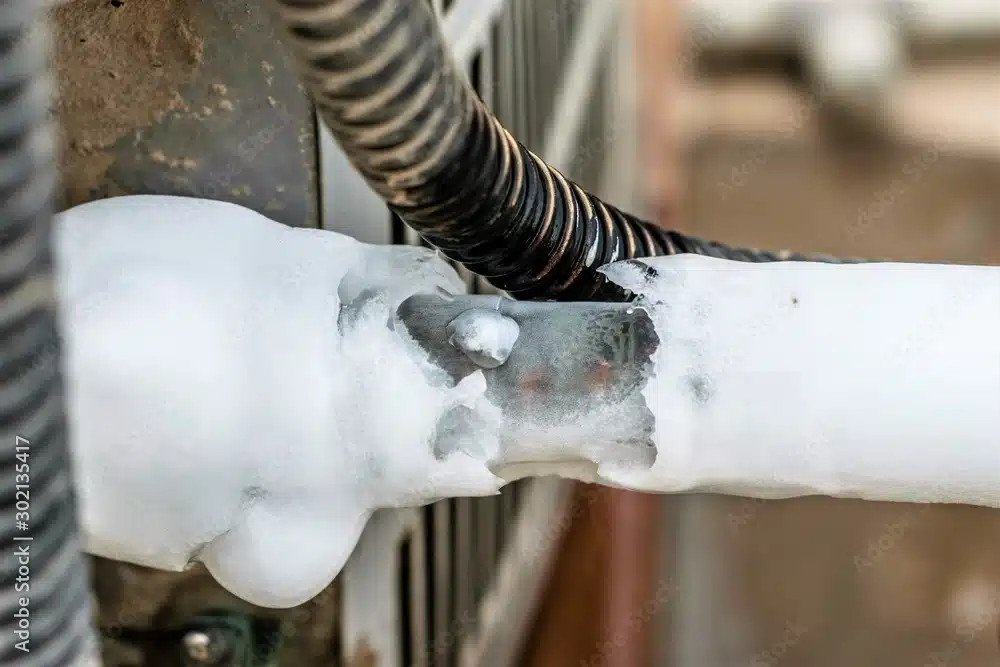
An AC refrigerant line covered in frost or ice means the refrigerant inside that line is flowing at a temperature below freezing. The two copper pipes running between the outdoor condenser and the indoor evaporator coil carry refrigerant at very different temperatures and pressures. Which line is frozen — and whether the ice is on the insulation, on the bare copper, or on both — tells you exactly where in the refrigeration circuit the problem is occurring. The larger pipe, wrapped in black foam insulation, is the suction line. It carries cold refrigerant gas from the indoor coil back to the compressor. The smaller bare copper pipe is the liquid line. It carries warm liquid refrigerant from the outdoor condenser to the indoor coil.
A frozen suction line is the most common scenario and means the evaporator coil inside the house is frozen. The ice started on the coil, and the sub-freezing refrigerant carried the cold back through the suction line to the outdoor unit. The cause is inadequate airflow across the indoor coil or low refrigerant. A frozen liquid line is rare and indicates a severe restriction — a clogged filter drier, a kinked line, or a failed metering device — that is causing the refrigerant to expand and freeze inside the liquid line instead of inside the evaporator coil. A frozen liquid line is an emergency. The compressor is being starved of refrigerant and is running without adequate cooling or lubrication.
Which Line Is Frozen and What It Means
| What Is Frozen | Appearance | Most Likely Cause | Urgency |
| Suction line only (the larger insulated pipe) | Frost or ice on the black foam or the exposed copper near the outdoor unit | Frozen indoor coil from low airflow or low refrigerant | 🟡 Medium — thaw and fix cause |
| Liquid line (the smaller bare pipe) | Frost or ice on bare copper — this pipe should always be warm | Restriction in liquid line, clogged filter drier, kinked pipe | 🔴 High — shut off immediately |
| Both lines frozen | Ice on both pipes at the outdoor unit | Severely low refrigerant, compressor not pumping, or restriction | 🔴 High — shut off immediately |
| Suction line frozen at outdoor unit, coil inside is fine | Frost only outside, indoor coil not frozen | Low refrigerant, liquid slugging, or compressor issue | 🔴 High — call technician |
1. Frozen Suction Line: The Indoor Coil Is Frozen
The suction line freezes because the evaporator coil inside the house is so cold — below 32°F — that the refrigerant returning through the suction line is still below freezing when it reaches the outdoor unit. The ice on the suction line at the outdoor unit is the tail end of an ice layer that began on the indoor coil. The indoor coil froze for one of two reasons: inadequate airflow (dirty filter, closed registers, failing blower motor) or low refrigerant (the refrigerant is boiling at too low a temperature).
Check the indoor coil by opening the air handler or furnace access panel. If the coil is a solid block of ice, turn the system off. Set the thermostat to OFF and the fan to ON. Let the blower run continuously for 1 to 4 hours to thaw the coil and the suction line. Replace the air filter. Open all supply registers. Verify no return grilles are blocked. After the system has thawed completely, restart it. If the suction line freezes again within days, the refrigerant charge is low and the system has a leak.
2. Frozen Liquid Line: A Restriction Is Blocking Refrigerant Flow
The liquid line carries warm, high-pressure liquid refrigerant from the outdoor condenser to the indoor metering device. It should be warm to the touch — roughly 90°F to 110°F. Frost or ice on the liquid line means the refrigerant is experiencing a pressure drop and a temperature drop at a point where neither should occur. A restriction — a partially clogged filter drier, a kinked copper line, or debris in the line — is causing the liquid refrigerant to flash to a gas prematurely, and the rapid expansion is absorbing enough heat to drop the temperature of the copper pipe below freezing.
Turn the system off immediately. A frozen liquid line means the compressor is being starved of refrigerant. The compressor relies on the returning suction gas to cool its motor windings. When the liquid line is restricted, the mass flow of refrigerant through the system drops, and the compressor overheats. A frozen liquid line is the most serious refrigerant line symptom. It requires a technician with pressure gauges to identify the restriction point. The most common restriction points are the filter drier (a small cylindrical component on the liquid line near the outdoor unit or the indoor coil), a kinked copper line where the line set was bent too sharply during installation, and the metering device at the indoor coil. Filter drier replacement costs $200 to $400. Kinked line repair costs $300 to $600. Metering device replacement costs $400 to $800.
The two-pipe temperature test: In normal cooling operation, the large insulated suction line should feel cold and sweaty — like a cold can of soda on a humid day. The small bare liquid line should feel warm — like a cup of coffee that has been sitting for 10 minutes. If the suction line is frozen, the indoor coil is frozen. If the liquid line is cold instead of warm, the system is severely low on refrigerant. If the liquid line is frozen, there is a restriction. Your hand on the two pipes tells you more in 5 seconds than any single diagnostic tool.
3. Low Refrigerant: Suction Line Freezes, Cooling Declines Gradually
When the refrigerant charge is low, the pressure in the evaporator coil drops. Lower pressure means a lower boiling point. The refrigerant that should be boiling at 40°F is now boiling at 25°F. The coil freezes. The sub-freezing refrigerant travels through the suction line, and frost forms on the suction line at the outdoor unit. The system was cooling normally for weeks or months, and then gradually the cooling output declined. The suction line went from cold and sweaty to frosty to a solid tube of ice over the course of several days or weeks.
Low refrigerant is confirmed by a technician connecting pressure gauges and measuring the superheat and subcooling. Properly maintaining your air conditioning system is the most effective way to prevent these technical issues from developing into expensive repairs. When a professional evaluates your equipment, they can identify small leaks or failing components before the system reaches a critical failure state. This proactive approach supports consistent cooling and helps manage long-term operational costs by ensuring every part of the refrigeration circuit is working within its intended parameters. Homeowners interested in establishing a routine checkup can see details regarding comprehensive maintenance plans that cover seasonal inspections and performance testing to keep their indoor environment comfortable year-round. The fix is to locate the leak — with an electronic detector or UV dye — repair it, evacuate the system, and recharge to the nameplate weight. Leak repair and recharge costs $500 to $1,500. Do not add refrigerant without finding and fixing the leak. Topping off a leaking system is a temporary fix that guarantees the leak will return, and the next time the charge will be even lower when the system fails.
4. Compressor Not Pumping: Both Lines at the Same Temperature
A compressor that is running but not pumping — because of a failed internal valve, a broken connecting rod, or a blown internal gasket — does not create the pressure differential that drives the refrigeration cycle. The suction line and the liquid line stabilize at the same temperature and pressure. Neither line is hot or cold. Both may accumulate frost because the stagnant refrigerant inside them slowly cools to the ambient temperature, and on a cool evening, that temperature can be below freezing.
A compressor that is not pumping produces a distinctive sound: it runs, but the sound is wrong — a rattling, knocking, or chattering noise from inside the compressor housing. The outdoor fan runs normally. The suction and liquid lines are at the same temperature. The system produces no cooling. A compressor that is not pumping must be replaced. Compressor replacement costs $1,200 to $2,500. If the system is more than 10 years old, replacing the outdoor unit or the entire system is usually more cost-effective than replacing the compressor alone.
How to Safely Thaw a Frozen AC Line
- Turn the thermostat to OFF and the fan to ON. The compressor stops. The blower runs. Warm return air flows across the frozen indoor coil and begins thawing it. The suction line at the outdoor unit thaws as the indoor coil thaws.
- Do not chip at the ice. The copper refrigerant lines are soft. A screwdriver or an ice pick punctures the line, releasing the entire refrigerant charge. A punctured line is a $500 to $1,500 repair.
- Wait 1 to 4 hours. The thaw time depends on the ice thickness. A light frost thaws in 30 to 60 minutes. A solid block of ice around the coil and the suction line takes 3 to 4 hours.
- Fix the root cause before restarting. Replace the filter. Open the registers. Clean the coil. If the line freezes again within days, the refrigerant charge is low.
FAQ: Common Questions About Frozen AC Lines
Why is the line frozen at the outdoor unit but the indoor coil is not frozen?
The indoor coil may be only partially frozen — ice on the lower portion or one end — and the ice that is there is not visible without removing the access panel. If the suction line at the outdoor unit is frozen, the indoor coil is cold enough to produce ice somewhere on its surface. Open the access panel and inspect the coil. If the coil is genuinely ice-free and the suction line is frozen, the refrigerant is boiling inside the suction line rather than inside the coil — a sign of a restriction or a critically low charge. Call a technician.
My heat pump lines are frozen in winter. Is that the same problem?
No. A heat pump in heating mode reverses the refrigeration cycle, and the outdoor coil becomes the evaporator. Frost on the outdoor unit and the refrigerant lines in winter is normal — the outdoor coil is extracting heat from air that is below freezing. The heat pump runs periodic defrost cycles to melt this frost. Ice on the lines during cooling mode is a problem. Frost on the outdoor unit during heating mode is normal, provided the defrost cycle clears it.
Touch Both Pipes. The Temperature Difference Tells the Story.
An AC line that is freezing up is a symptom of a problem upstream in the refrigeration circuit. The suction line freezes because the indoor coil is frozen. The liquid line freezes because there is a restriction. Both lines freezing or at the same temperature means the compressor is not pumping.
Walk outside to the condenser. Put one hand on the large insulated suction line. Put the other hand on the small bare liquid line. The suction line should be cold and sweaty. The liquid line should be warm. If the suction line is frozen, the indoor coil is frozen — check the filter and the airflow. If the liquid line is cold or frozen, the system is severely low on refrigerant or has a restriction — shut the system off and call a technician. Your two hands on the two pipes tell you more in 5 seconds than a guess based on symptoms alone.